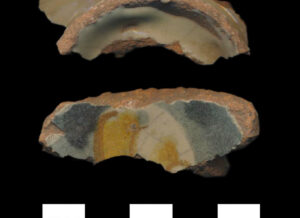


Fig Springs Polychrome majolica
- Wheel thrown
- 1540-1650
- Mexico City
Fig Springs polychrome, originally defined by John Goggin in 1968, is also known as “San Juan Polychrome.” It is one of the earliest American-made majolicas, or tin glazed pottery types. This type belongs to the Mexico City “Fine Ware” majolica category, which came into production around 1540. It does not appear regularly in Florida or Caribbean contexts until after about 1575.

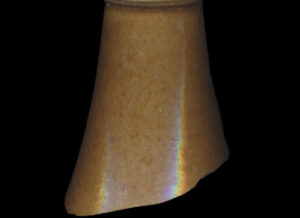
Stoneware bottle
- Wheel thrown
- Nineteenth century
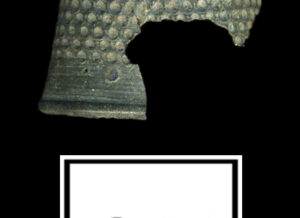
The distinctive brown color of this bottle top is known as Bristol glaze, a decorative style that become popular early in the nineteenth century. Typically, the bottom half of the bottle was dipped in a cream-colored glaze, creating a distinctive two-tone vessel. This type of pottery was introduced in the United Kingdom in 1835 and began to be produced in the United States about fifty years later. Therefore, this artifact would date to the post-colonial occupation of St. Augustine.

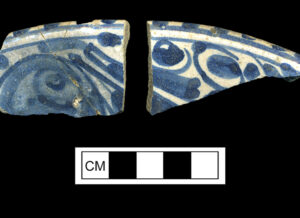
Ichtucknee Blue on White majolica
- Wheel thrown
- 1600-1650
- Spain
- 5004-90-21-76-166-WTS--00050; 5004-90-21-76-166-WTS--00054
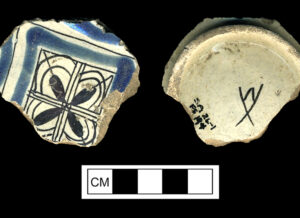
This early 17th century tin glazed pottery type was produced in Spain. It is characterized by a dark blue design painted on a cream-colored background. The designs typically emulate those found on late Ming dynasty Chinese porcelain, pottery that was highly valued by Europeans.

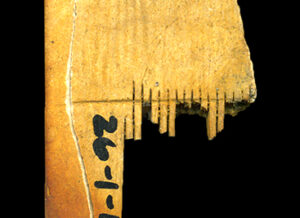
Bone lice comb
- Carved
- 5004-90-21-76-172-WTS--00010
Combs have been used for millennia for personal grooming and they are often recovered from archaeological sites. Very fine-toothed combs, like the one depicted here, are believed to have been used for the removal of lice and other parasites from hair.

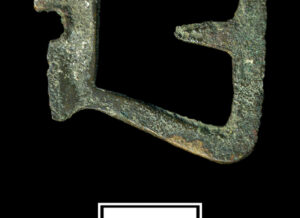
Clothing buckle tongue
- Unknown
- 5004-90-21-77-258-WTS--00019
Buckles have been used since Antiquity as clothing fasteners, including belts, shoes, knee closures, and hats. A variety of buckles have been recovered from St. Augustine house lots.

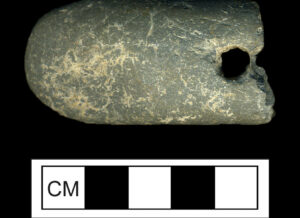
Possible pendant
This is a carefully ground and shaped stone artifact. Given its shape and the perforation, it is possibly a pendant.

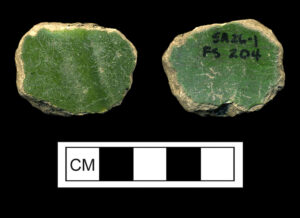
Gaming piece, green glazed olive jar
- Wheel thrown, then modified
- unknown
- 5004-90-21-77-204-WTS--00040
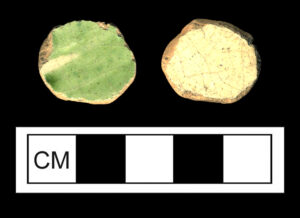
Roughly circular disks chipped from larger pieces of European and Native American pottery are common at St. Augustine and other Spanish colonial sites. These are believed to have been most commonly used as counters in various games, such as backgammon and checkers. This example from the de León site appears to be a preform, not quite completed.

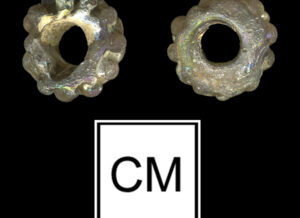
Glass raspberry bead
- wire wound
- Likely 1700s
- 5007-87-43-358-DRS--00024
So-called raspberry beads get their name from being shaped after the berry of the same name. This is an example of a wire-wound bead, created by winding heated glass around a metal wire and then shaping the glass while still soft.

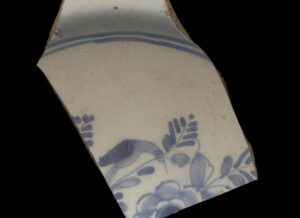
Delft plate fragment
- Wheel thrown
- 1571-1800
- 5007-87-43-429-DRS--00007
Delftware is a tin glazed ware made in both the Netherlands and England. It is often characterized by blue on white stylistic elements that mimic Chinese porcelain designs, such as the floral and hummingbird motifs seen here.

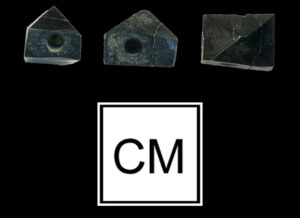
Jet pyramidal bead
- Carved
- Spain
- 5004-90-21-76-163-WTS--00100
“Jet” refers to the raw material of this unusually shaped bead. Jet is a gemstone quality coal that was carved and polished into a variety of ornaments. Large jet deposits are found in northwestern Spain, where workshops manufactured enormous quantities of objects that were widely distributed throughout Iberia and Spanish colonies.

Bone button blank
- Hand drilled
- 5007-87-43-138-DRS--00046
Bone buttons were manufactured from relatively flat animal bones, where a metal tool with a bit would be rotated into them to drill out a new button. The remains of this process are bone blanks.

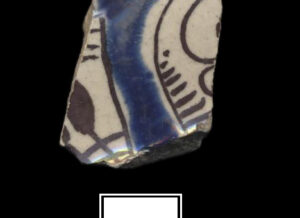
Puebla Polychrome majolica tableware sherd
- Wheel thrown
- 1650-1725
- 5007-87-43-160-DRS--00238
This multi-colored tin glaze ware (typically blue and black designs on a white background, but other colors are reported) was popular from the mid 1600s to early 1700s. It is characterized by a highly decorated painted surface, consisting of scrolls, lobes, curves, and linear motifs.

Scratch blue white salt glazed stoneware sherd
- Wheel thrown
- approximately 1735 - 1775
- 5007-87-43-248-DRS--00011
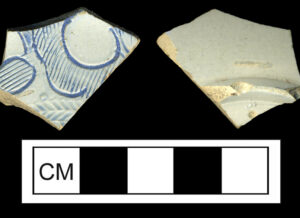
White salt glazed stoneware was very popular in the English colonies in the 1700s. This distinctive variety of pottery type was made by incising lines into the pottery and filling them with a cobalt blue oxide. The designs are usually floral or geometric patterns.

Ceramic gaming piece, majolica
- Wheel thrown, then carved
- Unknown
- 5007-87-43-352-DRS--00344
Roughly circular disks chipped from larger pieces of European and Native American pottery are common at St. Augustine and other Spanish colonial sites. These are believed to have been most commonly used as counters in various games, such as backgammon and checkers.

Bone button
- Carved
- Unknown
- 5006-92-84-72-48-DRS--00006
Buttons were made from a variety of materials. Bone buttons, like this one from the de la Cruz site, were common at St. Augustine. The five-hole variety occurs in late 18th-century and early 19th-century contexts.

Lead fishing weight
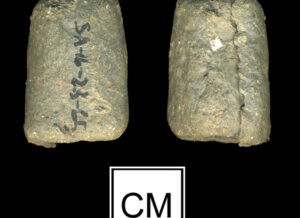
Lead line weights are common on Spanish colonial coastal settlements, reflecting the importance of fishing to their economies.

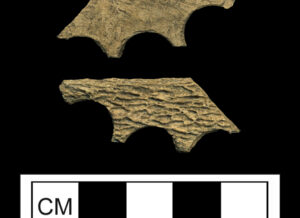
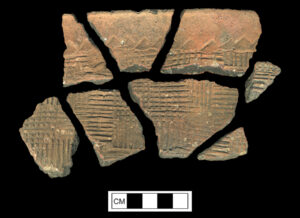
San Marcos pottery
- Coil manufactured
- approximately 1625 - early to mid 1700s
- 5006-92-84-72-69-DRS--00044-00051
San Marcos is a Native American pottery type characterized by grit temper and complex, impressed surface designs. The designs were applied with a carved wooden paddle before the pot was fired, creating a decorative motif known as complicated stamping. San Marcos is somewhat of an enigma. It first appeared somewhat suddenly after the arrival of Spaniards and was adopted widely by Indigenous groups along the South Carolina, Georgia and Florida coastal regions. But its origins remain debated.

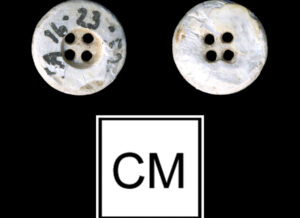
Shell button
- Carved
- post-1750
- 5006-92-84-72-52-DRS--00067
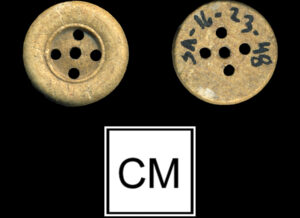
Carved shell buttons first appear at St. Augustine in the mid-1700s. Four-hole examples like this one from the de la Cruz site typically are found in early 19th-century contexts.

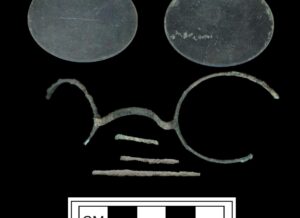
Spectacle frame and two glass lenses
- 1600s or later
- 5006-92-84-72-205-DRS--00002
There are European accounts of eyeglasses at least as far back as the 1200s A.D. They were being mass produced by the late 1400s, becoming popular with the invention of the printing press and the increasing availability of printed materials. These spectacle frames from the de la Cruz site are metal, an innovation that did not occur until the 1600s. Earlier frames were made of bone, horn, wood, or leather.

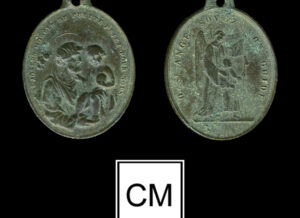
St. Joseph religious medal
- Stamped
- 5006-92-84-72-342-DRS--00133
Religious or devotional medals were widely produced throughout the Catholic world by the 1600s, although they have their origins in the early days of the Church. For the American colonies, shipping records indicate that very large numbers were shipped from Spain in the 1600s and 1700s. They were worn or used in various ways: suspended as part of a necklace, attached to clothing, and as elements of rosaries. This copper alloy (likely brass) medal from the de la Cruz household displays a common theme of Joseph holding the infant Jesus.

Sewing thimble
- Stamped
- post-1625
- 5006-92-84-72-65-DRS--00038
Metal thimbles were widely used throughout Europe by the 1300s. The example from the de la Cruz site is copper alloy, likely brass, which was the most common thimble material. More costly ones were made from gold, silver, and ivory. Indentations on earlier thimbles were made by manually punching or drilling each one. The standardized indentations on the de la Cruz thimble reflect the use of a knurling wheel, an innovation that appeared around 1625.

Clay tobacco pipe
- Mold made
- 5006-92-84-73-94-DRS--00028
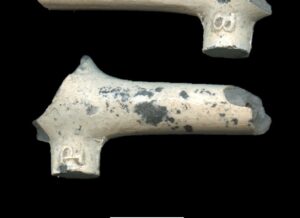
Spanish colonials preferred to smoke tobacco in the form of cigars and cigarillos. Clay smoking pipes are very rare prior to the 1700s on Spanish sites, and are still uncommon afterwards. In contrast, tobacco pipes are commonplace on English colonial sites and this example most likely dates to the British period at St. Augustine. They often had makers marks, such as the stamped “P” and “B” evident on this pipe’s heel (the projection at the base of the bowl that allowed the pipe to be rested on a flat surface).

Staffordshire slipware sherd
- Wheel thrown
- mid-1600s to late 1700s
- 5006-92-84-73-106-DRS--00016
This ceramic type was first made in Staffordshire, England in the 1600s but it came to be produced by a number of other centers in the country. It is a decorative lead-glazed pottery overlain with a “slip” (a mix of clay, water, and other liquids) in different colors to achieve a multi-colored effect, typically in yellow and brown.

Puebla Polychrome majolica tableware sherd
- Wheel thrown
- 1650-1725
- 5004-90-21-77-194-WTS--00100
This multi-colored tin glaze ware (typically blue and black designs on a white background, but other colors are reported) was popular from the mid 1600s to early 1700s. It is characterized by a highly decorated painted surface, consisting of scrolls, lobes, curves, and linear motifs.